
12 Things to Do in Alanya: Castles, Caves and Coves


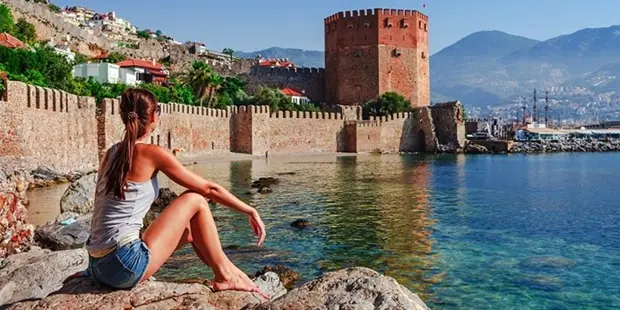
Alanya sits on a rocky peninsula on Türkiye’s Mediterranean coast, and its history runs far deeper than the beach towels suggest: the Greeks called it Korakesion, the Byzantines Kalonoros, and after Seljuk Sultan Alaeddin Keykubad I took it in 1221 it became Alaiye, his winter capital. The name Alanya was settled in 1935, during a visit by Atatürk, the founder of modern Turkey. These are the best things to do in Alanya, from the castle on the hill to the caves, beaches and river valleys around it.
1. Alanya Castle

The castle crowns a peninsula that rises about 250 m straight out of the sea. Its walls run about 6.5 km with some 140 towers, and most of what stands today dates from Keykubad’s 13th-century rebuild, though people have lived inside these walls without a break since Hellenistic times. A cable car now lifts visitors up from Cleopatra Beach to the Ehmedek quarter, and the inner citadels, İçkale and Ehmedek, are visited as museum areas, with cisterns, the ruins of a sultan’s palace, barracks and a small Byzantine chapel.
Stay for sunset at İçkale, then walk down through the lanes of old Ottoman-style houses below it.
2. The Red Tower (Kızıl Kule)

Alanya’s symbol is an octagonal tower completed in 1226 to guard the harbor, built for Keykubad by Ebu Ali Reha, a master builder brought from Aleppo. It stands 33 m tall. Its upper levels are faced in red brick, hence the name, and a cistern at its core kept the garrison supplied with water; the 17th-century Ottoman traveler Evliya Çelebi wrote that it could hold 2,000 men during a siege, a figure best read as a traveler’s flourish. Today it houses Alanya’s ethnography museum, and the climb to the top is rewarded with a full panorama of the harbor and the castle hill.
3. The Seljuk Shipyard (Tersane)

A short walk along the water from the Red Tower, Keykubad’s shipyard opens onto the sea through five pointed arches. It dates from the 1220s. Roughly 57 m along the waterfront and around 40 m deep, it was built for a sultan who, with a fleet on both the Black Sea and the Mediterranean, styled himself “sultan of the two seas” and signed trade agreements with Venice. Small museum displays on ships and seafaring now fill the vaults.
4. Alara Castle

About 37 km northwest of Alanya, this fortress spirals up a steep rock on the bank of the Alara River, where it protected Silk Road caravans resting at the Alarahan caravanserai just to the south. A stairway of roughly 180 steps is tunneled through the rock itself, and the ruins at the top include a small palace, garrison quarters, a mosque and a bath. The setting is the real draw: cliffs, river and pine forest all at once.
Access to the upper castle has changed over the years, so check locally before planning the climb.
5. The ancient city of Syedra

Southeast of Alanya, on the road toward Gazipaşa, Syedra was settled in the 7th century BCE and only abandoned in the 13th century CE. Its ruins include plastered cisterns, a bathhouse whose mosaic is now displayed in the Alanya Museum, a theater, a temple, shops along the main street, several churches and a cave decorated with Christian imagery that was probably used for baptisms. Put simply, it is a textbook Roman town on a hillside, with a sea view thrown in. Follow the marked paths.
6. The ancient city of Laertes

East of Alanya, at about 850 m on the slopes of Mount Cebelireis, Laertes belonged to the region the ancients called Rough Cilicia. Its oldest find is a fragment of an inscription in Phoenician from around the 7th century BCE, but most of what survives comes from its peak in the 2nd century CE. Look for the agora, a bath, an odeon, a sanctuary of Zeus Megistos, a temple of Apollo, a large cistern, a street of the emperors, house foundations and a necropolis. Few tour groups make it up here, which is half the appeal.
7. Damlataş Cave

Workers quarrying stone for Alanya’s harbor broke into this cave by accident in 1948, and it is widely described as the first cave in Türkiye opened to tourism. A passage about 50 m long leads to a chamber of stalactites and stalagmites said to have formed over 15,000 years, and the name, “dripping stone,” comes from the water that still drips from them. The air stays around 22°C (72°F) with about 95% humidity all year, which is why locals have long called it the “asthma cave.” That reputation rests on tradition and visitor reports, not medical studies: a curiosity, not a cure.
8. Damlataş and Cleopatra beaches

Alanya’s coastline is lined with long sandy beaches, and the most famous start right below the castle on the west side of the peninsula. Damlataş Beach begins in front of the cave, with fine golden sand, and runs into Cleopatra Beach, a long stretch that a popular legend says Cleopatra and Mark Antony swam at. Legend or not, the sand does the selling. The small rocky cove at the peninsula end, also named after the Egyptian queen, is the place for the clearest water.
On the east side of the peninsula, Keykubat and Bougainvillea (Begonvil) beaches are the other options.
9. The sea caves: Phosphorus, Lovers’ and Pirates’ caves

The peninsula is riddled with sea caves, and the boat tours from the harbor stop at three of them for a swim. Pirates’ Cave (Korsanlar Mağarası) comes with a legend of pirates stashing loot and captives here and hauling them up to the castle through a secret passage that has long since collapsed, while Phosphorus Cave (Fosforlu Mağara), on the Damlataş side, is known for the faint glow of its walls. Lovers’ Cave (Aşıklar Mağarası), to the southwest, is a 75 m tunnel that crosses the peninsula, reached by climbing up from the boat and walked half-crouched under a low ceiling. Its mouth on the Damlataş side sits about 8 m above the sea, and that is where the brave ones jump.
10. Dim Cave

About 11 km inland, at 232 m above sea level on the western slope of Mount Cebelireis, Dim Cave looks down over the Dim River valley. Its toured section runs for about 360 m through four galleries, 10 to 15 m wide and high, past stalactites, stalagmites and travertine formations, a far longer walk than the 50 m passage at Damlataş.
Is the best part at the very end? Yes: about 17 m below the entrance lies an underground lake with a surface of roughly 200 m².
11. Dim River

The Dim River is Alanya’s lifeline and, in summer, its open-air dining room. From below the Dim Dam almost down to the coast near Tosmur, its banks are lined with picnic spots, restaurants and tea gardens where tables are set right in the water under old plane trees, or on wooden platforms with floor cushions. Trout come from ponds on site, and the classic plan is a long lunch of fish with rakı, the anise spirit, followed by a dip in the cold pools and an afternoon nap in the shade. Rafting runs on another stretch of the river, and the hills around it have routes for mountain biking and hiking.
Bonus: Sapadere Canyon, one of the coolest things to do in Alanya

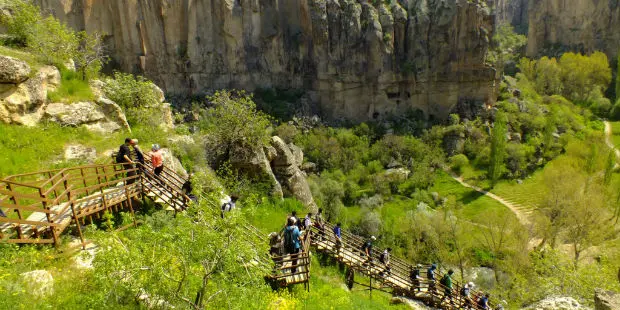
When the coast gets too hot, head about 45 km inland to the village of Sapadere, where the canyon walls rise around 400 m above a cold mountain stream. A walkway of roughly 600 m is fixed to the rock with steel supports and was built so it can be removed without damaging the gorge. At the far end a waterfall drops into a natural pool cold enough to make summer feel like a rumor. Shaded picnic areas and a simple restaurant sit at the entrance.
Beyond these 12 stops, Alanya adds lively nightlife and Turkish and international restaurants, plus sports from cycling to paragliding.
Sources: Alanya Castle (Wikipedia), Damlataş Cave (Wikipedia), Dim Cave (Showcaves.com)




Bir yanıt yazın