
Louvre Museum: 25 Things to Know Before You Visit


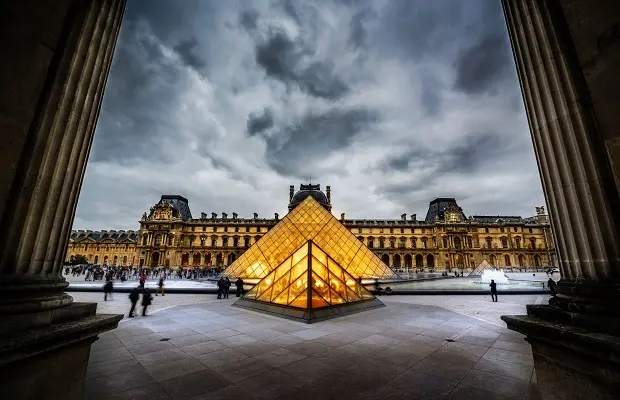
Artists sit cross-legged over their sketchbooks, the corridors hum, and every wall holds something famous: welcome to the Louvre Museum in Paris. Nobody sees all of it in a day, so it pays to arrive with a plan. Films have tried the sprint version, from Jean-Luc Godard’s Bande à part (1964) to Bernardo Bertolucci’s The Dreamers (2003), whose characters race through the galleries in homage to Godard, but that works better on screen than in real life.
1. From Fortress to Palace to Museum

The Louvre started life as a fortress. King Philip II (Philippe Auguste) built it in the late 12th century to guard the west side of Paris at a time when England still held Normandy. Where the name comes from is still debated. One theory links it to a wolf-hunting den, from the Latin lupus.
Charles V later turned the fortress into a royal residence, and Francis I began rebuilding it in French Renaissance style in 1546. Centuries of additions followed. Kings and queens lived here until the French Revolution changed its fate, and in 1793 the palace became a public museum.
2. Hours, Tickets and Getting There

According to the Louvre’s official hours and admission page, the museum opens from 9:00 to 18:00 on Monday, Thursday, Saturday and Sunday, and stays open until 21:00 on Wednesday and Friday. It is closed on Tuesdays and on January 1, May 1 and December 25. Last entry is one hour before closing.
A full-price ticket costs €32 for visitors from outside the European Economic Area and €22 for EEA residents. Under-18s go free. Booking a time slot online is recommended.
The nearest metro stations are Palais Royal-Musée du Louvre and Louvre-Rivoli.
3. Napoleon’s Museum, Then the Louvre Again

The museum opened on August 10, 1793, with 537 paintings, many of them confiscated from the church and the nobility. Structural problems closed it in 1796, and it reopened in 1801. Then came Napoleon. The collection swelled with works brought back from his campaigns, and for a while the building even carried his name as the Musée Napoléon.
After his defeat at Waterloo in 1815, many of those works went back to their former owners, and the Louvre took back its old name.
4. Mitterrand’s “Pharaoh” Pyramid
The glass pyramid came out of the Grand Louvre project that President François Mitterrand announced in 1981. Chinese-born American architect I. M. Pei unveiled the design in 1984, and the new entrance opened in 1989. The main pyramid stands 21.6 meters (71 feet) tall, flanked by three smaller pyramids that light the lobby below. Plenty of Parisians hated it at first. Critics said the modern glass clashed with the Renaissance palace, and political opponents mocked it as “Pharaoh François’ Pyramid,” a dig at a president supposedly building his own monument.
5. Not 666 Panes, but 673
Here’s a rumor that refused to die: the pyramid supposedly has exactly 666 glass panes, the “number of the beast.”
The figure turned up in a construction brochure in the 1980s, and Dan Brown’s The Da Vinci Code repeated it in 2003.
The real count, according to the Louvre Pyramid’s Wikipedia entry, is 673: 603 diamond-shaped panes and 70 triangles. The museum has confirmed the number.
6. 35,000 Works, About 9 Million Visitors a Year
The Louvre sits on the Right Bank of the Seine, in the heart of Paris’s 1st arrondissement. About 35,000 works are on display, drawn from a collection of roughly half a million objects, and the permanent galleries alone cover around 60,000 square meters.
It drew about 9 million visitors in 2025, the most of any art museum in the world. Seeing everything in detail in one day is impossible, so pick your priorities from the list below before you go.
7. The Less Crowded Door and 86 Statues

Lines at the main pyramid entrance in the Cour Napoléon can be long. The Porte des Lions, a side entrance at the western end of the Denon wing, is usually quieter, but it isn’t open every day, so check the museum’s map page before counting on it.
If you do queue in the main courtyard, look up.
The facades around you carry statues of 86 notable French figures, including Descartes, Molière, Rousseau, Abélard, Condorcet and Montesquieu.
8. Eight Departments, Three Wings

The collection is split into eight curatorial departments: Egyptian Antiquities; Near Eastern Antiquities; Greek, Etruscan and Roman Antiquities; Islamic Art; Sculpture; Decorative Arts; Paintings; and Prints and Drawings.
They’re spread across three wings. Richelieu runs along the north, Denon along the south by the Seine, and Sully wraps around the Cour Carrée to the east.
9. A Slice of Ancient Egypt in Paris

Mummies, sphinxes, tombstones covered in hieroglyphs: the Egyptian Antiquities department can feel as if half of Egypt has been moved to Paris. Many of the pieces came from excavations, including work by the French Institute in Cairo.
The department holds more than 50,000 objects spanning the Nile civilization from around 4000 BC to the 4th century AD.
10. Antiquity in All Its Glory

The Greek, Etruscan and Roman department runs from the dawn of the Hellenistic world in the Aegean to the last days of the Roman Empire. Expect marble sarcophagi, armor, gold and silver jewelry, frescoes and an almost endless parade of vases.
Two of the Louvre’s most famous statues live here too: the Winged Victory, found on the island of Samothrace, and the Venus de Milo, found on Milos.
11. Hammurabi: The Law and the King

The Near Eastern Antiquities department is rich in early Mesopotamian, Sumerian, Assyrian and Akkadian art. Its oldest pieces include Sumerian works from around 2500 BC and Akkadian ones from about 2270 BC. The star of the show: the stone stele carved with the laws of Hammurabi, king of Babylon.
Close behind is a winged bull with a human head, about 4 meters tall, that once guarded the gate of Assyrian King Sargon II’s palace. It dates from the 8th century BC and says a lot about how grand those palaces were.
12. The Tile Panel From Selim II’s Tomb

The Islamic Art department covers a huge stretch of the map, from Spain to India, with works from the Safavid, Ottoman and Mughal eras among many others. Ceramic dishes, tombstones, mosque lamps and mosaics are all on show.
One piece carries a long-running dispute: an Ottoman İznik tile panel from the tomb of Sultan Selim II, in the grounds of Hagia Sophia in Istanbul, Türkiye. It was removed during a restoration in the 1890s and reached the Louvre in 1895, and the Cultural Property Disputes Resource records Turkey’s request for its return as unresolved. Nearby is another highlight, the Pyxis of al-Mughira, an ivory box carved in 968 near Córdoba with court scenes, riders and animals.
13. Jewels, Carpets and Royal Furniture

The Decorative Arts department was created when precious objects and furniture were separated from the sculpture collection. It covers roughly the Middle Ages to the 19th century: gold, bronze and ivory pieces, fine carpets, furniture, and the French royal jewels and crowns.
Many of the rarest items came from the royal collections and from the former National Furniture Museum.
14. Canova’s Cupid and Psyche

The Sculpture department gathers French sculpture from the Middle Ages through the 19th century, Italian and Spanish works from the 11th to the 19th century, and Northern European pieces from the 12th to the 19th century.
Look for Antonio Canova’s Psyche Revived by Cupid’s Kiss, the marble pair caught in the instant before a kiss.
15. Who’s on the Walls?

The Paintings department shows French, Italian, Spanish, Dutch and German painting from the Middle Ages to the 19th century. The roll call is ridiculous.
Leonardo da Vinci, Rembrandt, Albrecht Dürer, Johannes Vermeer and Eugène Delacroix are only the start.
16. Even the Sketches Made the Cut

The Prints and Drawings department brings together the French, Italian and Northern schools, along with a documentation room, a study room and temporary exhibitions. Paper is fragile. That’s why these works are mostly shown in rotating displays.
Handwritten notes, drawings, woodcuts and lithographs by many famous artists are kept here.
17. Just Follow the Mona Lisa Signs
Leonardo da Vinci’s Mona Lisa, La Gioconda in Italian, is the Louvre’s best-known treasure. Wikipedia’s Mona Lisa entry puts the number of people who see it at about 10 million a year (a 2019 figure), which explains the signs pointing the way. Honestly, you could just drift along with the crowd and still find it. Since 2005 it has hung in the Salle des États, behind bulletproof glass in a climate-controlled case kept between 18 and 21 °C. Expect a short look after a queue. The enigmatic smile, the barely visible eyebrows and the folded hands are why everyone came.
18. Suleiman the Magnificent at the Wedding

Directly across from the Mona Lisa hangs Paolo Veronese’s The Wedding at Cana, finished in 1563. At 6.77 by 9.94 meters, it is the largest painting in the Louvre’s collection, painted by one of the great masters of 16th-century Venice. The scene is the wedding feast where, according to the Gospel of John, Jesus turned water into wine. He sits at the center. Around him crowd guests in Renaissance dress, some of whom tradition identifies as rulers of the day, and one of them, down in the lower left, is said to be the Ottoman sultan Suleiman the Magnificent.
That puts the Louvre’s best-known treasure and its largest painting in the same room, facing each other, so anyone photographing one stands with their back to the other.
19. The Oath of the Horatii, Neoclassicism’s Big Moment

Jacques-Louis David painted The Oath of the Horatii in 1784. It tells a legend from 7th-century BC Rome: three brothers swear before their proud father to defeat the enemy at the cost of their own lives, while the women of the family grieve beside them.
With its stripped-back composition, life-size figures and vivid costumes, it became a landmark of Neoclassicism and set the tone for a new style in Europe.
20. The Raft of the Medusa, a Real Disaster

Théodore Géricault was just 27 when he painted The Raft of the Medusa in 1818-1819. It’s now one of the icons of French Romanticism. The canvas shows the aftermath of a real shipwreck off the coast of Mauritania in 1816. To get it right, Géricault went to grim lengths: he interviewed two survivors and studied corpses in a morgue.
21. Two Masterpieces by Michelangelo

Michelangelo carved the Dying Slave and the Rebellious Slave between 1513 and 1516. Both were meant for the monumental tomb of Pope Julius II.
The tomb’s design changed again and again, and the finished version ended up far smaller than planned, without these two figures.
22. Venus de Milo, an Ideal of Beauty

The Venus de Milo was carved in the 2nd century BC, probably sometime between 160 and 110 BC, and found on the Greek island of Milos in 1820. It’s usually taken to represent Aphrodite, the Greek goddess of love, known to the Romans as Venus.
Few original Greek statues of this quality survive. That alone makes it a must-see.
23. Napoleon Crowns Himself While the Pope Looks On

Jacques-Louis David finished The Coronation of the Emperor Napoleon I in 1807, and it’s one of the key works of Neoclassicism. It shows the 1804 ceremony in Notre-Dame Cathedral, at the moment Napoleon crowns his wife, Joséphine de Beauharnais.
Napoleon had summoned the pope to Paris for the occasion, then placed the crown on his own head instead of receiving it. The pope ended up as little more than an extra.
24. No Arms, but Wings: The Winged Victory

The Winged Victory of Samothrace is a marble statue of Nike, the Greek goddess of victory, carved around 190 BC. It ranks among the greatest works of the Hellenistic period. It once stood in the Sanctuary of the Great Gods on Samothrace. The head and arms were never found. Even so, the way the stone captures wind-blown drapery is worth the climb up the staircase.
25. Liberty Leads the Way

Eugène Delacroix’s Liberty Leading the People is a masterpiece of French painting. It commemorates the July Revolution of 1830, three days of uprising that toppled King Charles X. A woman personifying Liberty strides forward with the French flag in one hand and a musket in the other, leading the rebels over the barricades. It has become one of the most recognizable political images in Western art.
Sources: Musée du Louvre, Hours and admission; Wikipedia, Louvre; Wikipedia, Louvre Pyramid; Cultural Property Disputes Resource, Tiles from the Tomb of Sultan Selim II.










Bir yanıt yazın