
Sancaklar Mosque Istanbul: What to Know Before You Go


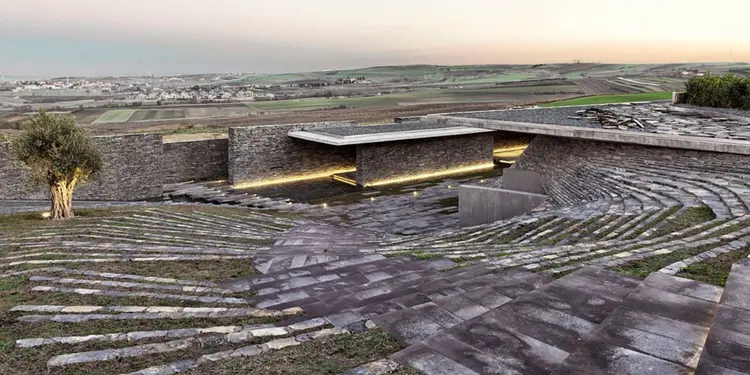
Most mosques announce themselves from blocks away. Sancaklar Mosque, Istanbul, does the opposite. Tucked into a hillside in the city’s Büyükçekmece district, it’s easy to walk right past without noticing a building is there at all. Completed in 2012 by architect Emre Arolat and his team, it’s become one of the most discussed works of contemporary mosque design anywhere in the world, and it earns that attention by quietly rejecting almost every convention the word “mosque” brings to mind.
A building that disappears into the land
The first thing visitors notice about Sancaklar Mosque is how little there is to notice. Rather than rising above its surroundings, the structure is cut into the natural slope of the terrain, so that from the road it reads less as architecture than as landscape. That’s no accident. It’s a deliberate refusal of spectacle, not a budget shortcut or an awkward plot the architects had to work around. Walking in confirms the impression. There’s no soaring dome overhead, no ornate portal announcing arrival. Instead, the path narrows and dips downward, a descent that feels physical and mental at once, as if the building wants you to leave the noise of the world at the threshold before you ever reach the prayer hall.
Light does the talking
If Sancaklar Mosque has a signature feature, it’s light—or more precisely, the restraint with which it’s used.
Daylight doesn’t flood the interior. It’s filtered in through narrow openings cut into raw stone, so the hall shifts in tone through the day without ever feeling theatrical, and that balance of shadow and glow turns the prayer space into something closer to a quiet interior landscape than a stage. Where older mosque interiors often lean on pattern, tilework, and calligraphy to hold the eye, this one asks for stillness instead. And it works. Strip away the usual visual noise, and silence becomes the main event.
A conscious break from the traditional mosque form
What Sancaklar Mosque doesn’t have is as telling as what it does. There’s no dome in the classical Ottoman sense, and the minaret is a tower that looks closer to an observation post than to the slender spires most visitors associate with Istanbul’s skyline. Everything else stays low and horizontal. Those choices drew real criticism. When the mosque opened, some people felt a place of worship should look recognizably like one. It’s a fair point, and there’s no tidy answer to it. But the project was never trying to reproduce a familiar form; it was trying to rethink what the experience of prayer could feel like stripped down to its essentials.
Inside, the mihrab sits without ornamentation. The stone walls are left in their raw, unfinished state, and the whole space feels like an exercise in subtraction rather than decoration.
Concrete, stone, and the power of leaving things alone
Material choices follow the same logic. Concrete and stone appear largely untouched, so texture itself becomes the decoration—rough surfaces doing the work that carved detail or tilework might do elsewhere. The building doesn’t try to look like a finished, polished object; it reads more like something that belongs to its site, aging alongside it rather than standing apart from it. Leaving the walls raw wasn’t a shortcut, though. It lets the building weather and change with time instead of staying fixed the way a heavily finished surface would. The structure was built to live with its surroundings, not sit on top of them.
Sancaklar Mosque Istanbul: a quieter kind of landmark
Sancaklar Mosque is genuinely unusual. Its most striking quality? Restraint.
It isn’t trying to be an emblem you photograph from the road; it’s built to be felt once you’re standing inside it. That’s part of why it keeps coming up in conversations about contemporary mosque architecture—not just as one example of a new direction, but as a standing question for the field: how visible does a place of worship actually need to be?
International recognition followed. It was named 2015 Religious Building of the Year by ArchDaily and picked up a RIBA International Award for Excellence in 2018. It also caught the eye of classicist Mary Beard, who singled it out in the BBC series Civilisations as one of the most striking religious buildings of modern times.
Sources: Emre Arolat Architecture, project page, ArchDaily, Sancaklar Mosque / EAA – Emre Arolat Architecture, Wikipedia, Sancaklar Mosque









Bir yanıt yazın