
34 Caves in Turkey Worth Going Underground For


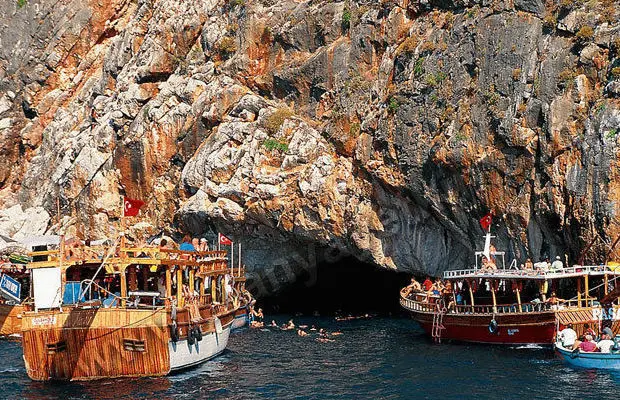
Beyond the beach resorts, Türkiye hides one of the Mediterranean’s richest cave landscapes: limestone halls hung with stalactites, a lake inside a mountain, a salt mine shaped like a motorway tunnel. This list of caves in Turkey runs from show caves with walkways and cafés to wild systems that belong to trained cavers. Check access and opening status locally before you go, since water levels and permits change.
1. Altınbeşik Cave, Antalya

Altınbeşik sits on the western slope of the steep Manavgat Valley in Antalya’s İbradı district, inside a national park. It holds Turkey’s largest underground lake, one that Turkish tourism sources rank among the longest cave lakes in the world, and boats have been used on it. A road leads to the entrance. Still, the cave was closed to visitors during the pandemic, so confirm it is open before making the trip.
2. Yalan Dünya Cave, Antalya

The mountain above Beyrebucak village, in Gazipaşa district, swallows this cave about 400 meters deep. Its formations are still growing. In yellow, white and brown, they range from huge stalactites and stalagmites to small hollows.
The name means “False World”, which suits a place that looks nothing like the hillside above it.
3. Cüceler Cave, Antalya

On the road through Sapadere Canyon, 17 km from central Alanya, the cave’s entrance terrace looks over a valley in every shade of green. Inside is the second reason to stop: colorful stalactites and stalagmites.
4. Beldibi Cave, Antalya
Beldibi is an archaeological site. Between Antalya and Kemer, 19 km from Kemer, it ranks among the region’s key sources on prehistoric life, with excavations that turned up Paleolithic, Mesolithic and Neolithic finds. On the rock shelter’s walls, simplified drawings of people, ibex and deer can still be made out.
5. Karain Cave, Antalya

Karain lies in Yağca village, about 30 km northwest of Antalya and roughly 450 meters above sea level. People kept coming back. From the Lower Paleolithic through the Early Bronze Age, they used it long enough to leave a cultural layer up to 11 meters thick.
Finds from the digs are displayed at the Antalya Museum and the nearby Karain Museum, which makes this the place for anyone who wants to feel the age of the region.
6. Damlataş Cave, Alanya

Damlataş is small: around 30 meters long, right beside Alanya’s coastal center. Its humidity runs near 90 percent and its air is rich in carbon dioxide, which is why people with asthma have long made the trip. The benefit, frankly, is anecdotal. Treat it as a curiosity rather than a treatment, and speak to a doctor if you have a respiratory condition.
7. Dim Cave, Alanya
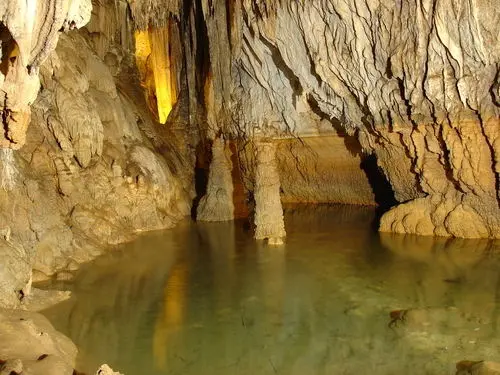
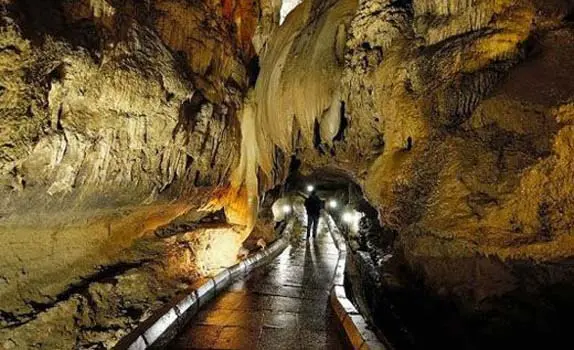
About 11 km from Alanya’s center and 145 km from Antalya, Dim Cave is arranged in four main halls linked by passages. Stalactites, stalagmites, columns, curtains and “macaroni” strands fill every room.
The terrace café above the entrance has a viewing scope aimed at Alanya and the sea.
8. Tilkiler Cave, Antalya

Tilkiler (“Foxes”) lies in the Oymapınar Dam area of Manavgat and runs 7 km, horizontally, with an active stream. Engineers found it by accident. A survey gallery for the dam broke into a natural passage, and the cave turned out to hold extra scientific interest because it formed in conglomerate rock. Water rises in spring, so timing matters.
9. Kaklık Cave, Denizli

Kaklık is in the town of the same name in Honaz, 30 km from Denizli on the Ankara road. Here, stalactites and stalagmites share space with white travertine steps much like those of nearby Pamukkale, and thermal water pools inside as well. Think Pamukkale, compressed underground.
10. Keloğlan Cave, Denizli

In the Dodurga area on the slopes of Karadağ, Keloğlan is a fossil cave about 150 meters long. Fossil, here, means its water has long stopped carving it. That is why it is so full of stalactites, stalagmites and thin “macaroni” strands.
Keloğlan is a folk-tale hero, a bald boy who outwits the powerful.
11. Astım Cave, Mersin

Astım (“Asthma”) Cave lies 15 meters below ground in Narlıkuyu, near Silifke. It is known for oddly shaped stalactites and stalagmites, and for a local belief that its air helps asthma. Folk wisdom, not medicine. Narlıkuyu also has other caves and a Roman mosaic nearby, so the stop pairs well with a day on Mersin’s coast.
12. Çukurpınar Cave, Mersin
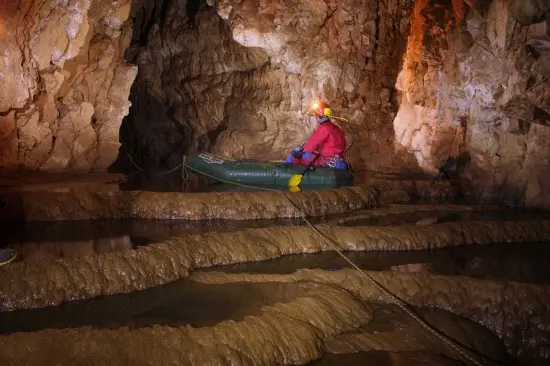
Çukurpınar is 25 km from Anamur, close to Olucak village, and easy to reach by road. Turkish caving sources describe it as one of the deepest caves in the world and among the deepest explorable ones in Türkiye, with galleries even at its lowest levels.
Put plainly, it is a sport-caving destination, not a stroll.
13. Aynalıgöl (Gilindire) Cave, Mersin

Aynalıgöl, also called Gilindire, lies in Aydıncık district. A shepherd found it by chance in 1999, 10 km from Gemi Durağı. At the end of the cave a lake appears, and the stalactites and stalagmites keep going underwater, so the view below the surface matches the one above. Photographers, take note.
14. Ballıca Cave, Tokat
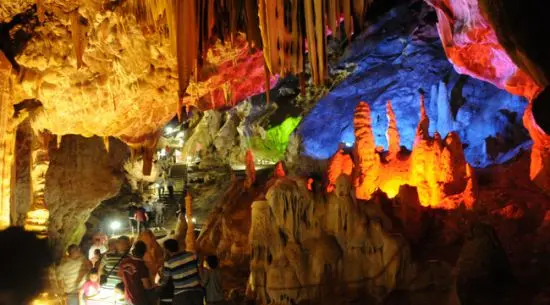
Ballıca, in Tokat’s Pazar district, is one of the biggest and most spectacular caves in the country. Parts of it remain unexplored and closed. The visitor route still covers about 680 meters through eight halls. Local sources claim the air holds several times the usual share of oxygen, which is popularly said to ease breathing; read that as marketing rather than medicine.
15. İnsuyu Cave, Burdur
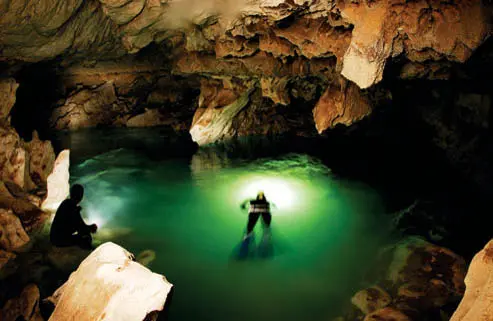
İnsuyu is 13 km southeast of Burdur, in the Çatalağıl village area, off the Burdur-Antalya road via a 900-meter paved side road. Dense stalactite groups and small lakes fill the passages.
It is an easy detour for anyone driving between the Lakes District and the coast.
16. Fosforlu Cave, Muğla

Fosforlu, “Phosphorescent”, is the third of the sea caves beside Marmaris’s own Damlataş Cave, not to be confused with the Alanya one above. A small boat takes visitors inside. It looks bright at night, and the glow shows by day too. Hence the name. The geology is as interesting as the shimmer.
17. Çankırı Salt Cave, Çankırı

Çankırı has some of Türkiye’s largest rock-salt reserves. This cave was dug, not carved: it was made for salt mining, and past the entrance the tunnels look like a modern road, covering about 8 km over roughly 800 decares. Many galleries are open for visits.
Here is the twist: salt is still extracted here, so this is a working mine as much as an attraction.
18. Oylat Cave, Bursa

Oylat lies 19 to 20 km from İnegöl, on the road toward Ankara. Road signs make it easy. It formed along fault lines, where water widened the cracks after earthquakes and dripping water then built its stalactites and stalagmites. The nearby Oylat thermal springs are a natural add-on.
19. Ayvaini Cave, Bursa

Ayvaini is in Ayva village in Nilüfer district, near Lake Uluabat, and is counted among Türkiye’s longest caves. It has two entrances, 5.5 km apart. Use the one at Ayva village; the other is in Doğanalan village.
The lush vegetation on the approach is part of the draw.
20. Aynalı Cave, Amasya
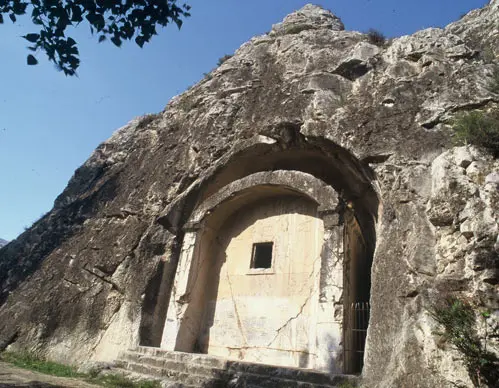
This is no natural cave but a rock-cut tomb, the best known of the many in the Amasya valley. The outside shows skilled stonework, with polished surfaces. Inside are two rooms. One is rectangular, the main burial chamber; the other is square, with colored wall paintings thought to be Byzantine, from around the 11th century.
21. Çal Cave, Trabzon

Çal is 5 km southwest of Düzköy in Trabzon province, about 1,050 meters above sea level in Çal village. A small stream runs through it. Above stands a historic castle.
Pair it with a Trabzon trip that already takes in Sümela Monastery.
22. Buzluk Cave, Ağrı
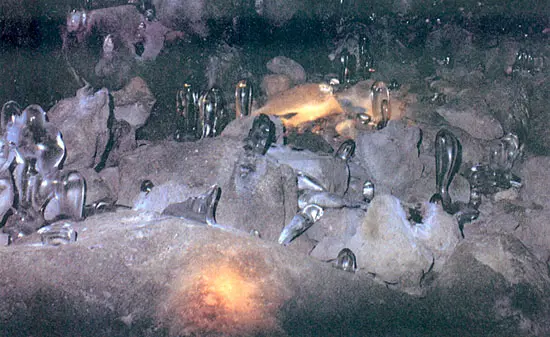
Buzluk is a lava-tube cave on the southern foot of Little Ararat, 3 km northeast of Hallaç village, on the same lava-tunnel system as the Meteor Crater. Ice blocks glitter like crystal when lit. Villagers use the cave as a water source. Cold air flows out in summer and warm air in winter, a natural quirk that the name Buzluk (“icy place”) hints at.
23. Karaca Cave, Gümüşhane

Karaca lies in Karaca neighborhood in Torul district, 15 km northwest of Gümüşhane. Nature alone did the sculpting. From entrance to end, colored stalactites line the cave.
It fits neatly into a drive across the eastern Black Sea region.
24. Cehennemağzı Caves, Zonguldak

Cehennemağzı (“Mouth of Hell”) is in İnönü neighborhood in Ereğli, 50 km from the center of Zonguldak. A gateway to the underworld on the Black Sea coast? This is the ancient Acheron Valley. Greek myth placed an entrance to the underworld here, and three caves used in Roman and Byzantine times now form an archaeological site run by the Ereğli Museum.
25. Kızılelma Cave, Zonguldak

In Ayiçi neighborhood, 7 to 8 km southeast of Kilimli, Kızılelma is one of Türkiye’s longest caves, about 6.6 km long and 114 meters deep. The main gallery and side branches carry formations in many colors. An underground stream and lakes add variety. Small bats live in the fossil sections near the entrance.
26. Gökgöl Cave, Zonguldak

Gökgöl is just 3 km from central Zonguldak, beside the Zonguldak-Ankara road. Access is easy. It runs 3,350 meters and contains almost every formation type: stalactites, stalagmites, columns, flag-shaped drips and macaroni strands over the stream.
Some visitors come for its air. The asthma claims, as at Damlataş and Astım, are folk belief.
27. Tınaztepe Cave, Konya
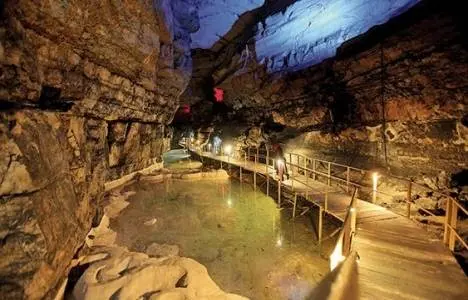
Tınaztepe, in Seydişehir, is a horizontal cave about 1,580 meters long, apart from a 30-meter descent at the end. It has fossil and active parts. In spring, boats are needed to cross up to five lakes in the fossil section, but in autumn, when the water drops, the same gallery can be walked. After the fifth lake the descent leads to the Great Hall, which ends in a lake. A spring visit and an autumn visit can feel like two different caves.
28. Ilgarini Cave, Kastamonu

Ilgarini sits at about 1,250 meters in Pınarbaşı district, Kastamonu. Its rock is said to have formed over 160 to 220 million years, while the stalactites inside are far younger, about a million years old. Local sources call it one of the largest caves in the world. That is hard to check. Size aside, this is a rare Black Sea mountain cave.
29. Dupnisa Cave, Kırklareli

Dupnisa is 5 to 6 km southwest of Sarpdere village in Demirköy. It has three entrances and about 3,000 meters of passages, the first 1,000 of which are filled with water. It is also where the Rezve stream, which marks the Türkiye-Bulgaria border, begins. A good stop for anyone driving toward Thrace’s forests.
30. Yazören Cave, Balıkesir

Yazören is in Savaştepe district and about 3,500 meters long. It is semi-active. The surface water of a wide area drains out of it, flowing strongly in winter and spring, and the marks on its walls record thousands of years of that flow.
31. Yarımburgaz Cave, İstanbul
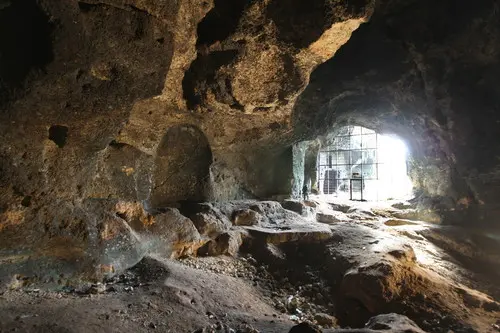
Yarımburgaz is on Istanbul’s European side, about 22 km northwest of the center and 1 km north of Altınşehir, 1.5 km from the north shore of Lake Küçükçekmece. It was declared a first-degree archaeological and natural site in 2001. The road from Halkalı and Altınşehir makes it one of the few caves reachable from the city without a long drive. Access to the interior may be restricted, so ask locally.
32. Mencilis Cave, Karabük

Mencilis, also called Bulak Cave, is in Bulak village on the Safranbolu border, with an entrance on steep cliffs. The cave is 6.5 km long, of which 2.5 km is mapped. A 380-meter stretch has lighting and a walking path for visitors. It is still hydrologically active, with underground rivers, pools and waterfalls, and is a protected natural asset. Safranbolu makes a good base.
33. Taşkuyu Cave, Mersin

Taşkuyu sits inside Taşkuyu village, 10 km from Tarsus, and is about 470 meters long. On top of stalactites and stalagmites, it has eccentrics, twisting formations that defy gravity, and cave pearls, both rare in Türkiye.
Few caves in Mersin offer such variety in so little space.
34. Pınargözü Cave, Isparta

Pınargözü, in Yenişarbademli district, is generally regarded as Türkiye’s longest cave. Turkish tourism sources give 12 km, reached in 1991. Some estimates run higher. Set that against Damlataş in Alanya, around 30 meters end to end, and the range of this list comes into focus: one is a short walk off the beach, the other an expedition. A siphon starts 50 meters from the entrance, and waterfalls and travertine require climbing, so only experienced cavers should go. How far it really goes is still an open question, and exploration is under way.
Sources: Ministry of Culture and Tourism, Caverns of Antalya, Ministry of Culture and Tourism, Caves of Isparta, Daily Sabah on Altınbeşik Cave


Bir yanıt yazın