
Damlataş Cave: Türkiye’s First Show Cave in Alanya


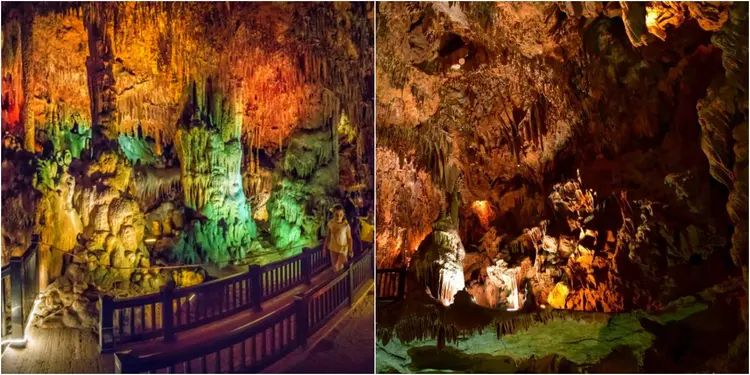
In 1948, quarry workers cutting stone on the western edge of Alanya, on Türkiye’s Mediterranean coast, broke into a hidden chamber full of dripstones: Damlataş Cave. It soon became a sight in its own right, and it’s widely described as the first cave in the country opened to tourism. It also draws a second kind of visitor, people with asthma who come for its steady, humid air.
Türkiye’s First Show Cave: Damlataş

The discovery was an accident. Stone was being quarried for the construction of Alanya’s harbor when the workers opened a way into the cave, and Damlataş Cave, decorated with stalactites and stalagmites, was later opened to visitors. Inside, a passage about 50 meters long and up to 15 meters high leads in from the entrance. Beyond it, a cylindrical shaft drops down to the cave floor.
The cave’s dripstones are thought to have taken around 15,000 years to form, and the climate inside barely changes with the seasons. The Turkish Ministry of Culture and Tourism gives a constant 22°C, 95% humidity and a steady air pressure of 760 mm of mercury, with an atmosphere of about 71% nitrogen and 20.5% oxygen plus traces of ions and natural radioactivity. Whatever the season outside, the readings stay put. Step in from a summer afternoon on the beach and that damp, mild air is usually the first thing anyone notices.
The name comes from the water that kept dripping from the stalactites when the cave was found: in Turkish, damla means “drop” and taş means “stone.” Around Alanya, though, it’s just as often called the asthma cave, after the long-held local belief that its air eases breathing problems. People with asthma still come on a doctor’s referral.
Location helps, too.
The cave sits close to central Alanya, right by the beach, so in summer it’s a fixture on many visitors’ Antalya itineraries. A small market area surrounds the entrance, and Atatürk Park, laid out for the 100th anniversary of the Turkish Republic, is next door.
How Did Damlataş Cave Form?

Those 15,000 years of growth start with rain, nothing more dramatic than that. Seeping through the limestone ceiling, the water carries dissolved minerals, and each drop leaves a thin film of calcite behind as it hangs and falls. Over millennia, the deposits on the ceiling grew into stalactites, while the ones left where the drops land built up into stalagmites. Slow and steady: the cave’s constant humidity and temperature saw to that.
What Makes Damlataş Cave Special?

What sets Damlataş apart from most show caves is its role as a place of therapy. Every season it hosts people with asthma, drawn by the belief that the balance of gases, the humidity and the stable temperature inside help the respiratory system. The evidence? Largely anecdotal, and to be clear, the cave is no substitute for medical treatment. Anyone interested should talk to their own doctor first.
Those who come with a doctor’s referral spend four hours a day in the cave for 21 days. They’re kept in an area separate from the tourist route, and the municipality has set aside early morning hours for them, before regular visitors arrive. Their fee is separate, and lower.
A regular sightseer, by comparison, usually walks the whole route in well under an hour.
How to Get to Damlataş Cave

Damlataş Cave lies about 3 km from Alanya’s city center, on the western side of the peninsula below Alanya Castle, at Damlataş Caddesi 81. From most hotels in town, it’s a short drive or a ride on one of the regular city buses. Alanya is about 124 km east of Antalya by road.
If you’re flying, Gazipaşa-Alanya Airport is the closest, around 40 km to the east, while Antalya Airport has far more international flights.
Opening hours and tickets
Hours change with the season. In summer, the cave stays open later. Ticket prices also change often, so check the current hours and fees with the Alanya municipality or at the entrance before you go. Discounts and free entry apply to some groups, including young children, older visitors and people with disabilities.
More things to see in Alanya
Alanya Castle, the ancient city of Syedra, Dim Cave and the Dim River valley are all within easy reach. In town, you can ride the cable car up to the castle, swim at Cleopatra Beach, and see the Red Tower (Kızıl Kule), the medieval Seljuk shipyard, the harbor and the Alanya Archaeological Museum. Farther inland, Sapadere Canyon is a popular half-day trip. For families, a water park rounds out the list. Honestly, picking among them is the hard part.
Sources: Ministry of Culture and Tourism, Kültür Portalı: Damlataş Mağarası, Wikipedia: Damlataş Cave









Bir yanıt yazın