
5 Underground Cities in Turkey Worth Exploring


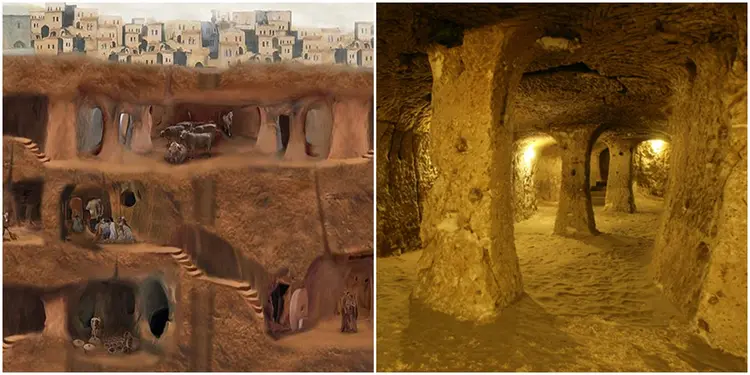
Long before anyone sold tickets to them, the soft volcanic rock of central Türkiye was carved into whole towns below ground, complete with stables, chapels, wine presses and stone doors that rolled shut against raiders. The underground cities in Turkey still keep plenty of secrets, starting with who dug the first tunnels. These five, spread across Nevşehir, Kayseri, Yozgat and Kırşehir provinces, show how different one hidden world can look from the next.
1. Derinkuyu, the largest of the underground cities in Turkey

Cappadocia is famous for its fairy chimneys. Some of its most remarkable engineering, though, sits out of sight. Derinkuyu, whose name means “deep well,” is the largest excavated underground city in Turkey and reaches roughly 85 m (280 ft) below the surface. Its first tunnels may have been cut by the Phrygians in the 8th-7th centuries BC, Christian communities enlarged it in late Roman times, and it took its full shape in the Byzantine era, when it could shelter up to about 20,000 people together with their animals and food stores.
What’s down there? Large ventilation shafts, a 55 m shaft that seems to have served as a well, stables, wine and oil presses, refectories and chapels, plus a barrel-vaulted room on the second level often described as a religious school. Nobody planned its modern rediscovery. In 1963 a resident renovating his house knocked through a wall and found, of all things, a tunnel behind it. Derinkuyu is part of the UNESCO-listed Göreme National Park and the Rock Sites of Cappadocia. Expect low ceilings and steep, narrow stairs.
2. Kaymaklı, where the village sits on the tunnels

About 19 km from Nevşehir on the road to Niğde, Kaymaklı is the other big name in Cappadocia. Visitors see only four levels. They hold a stable with a millstone door, a church with two apses and a baptismal font, kitchens, presses and storerooms lined with spaces for earthenware jars.
Its origins are murkier than the guidebook versions suggest.
The Phrygians may have carved the first caves, but most of the city was dug by Christians from the 8th century AD on and greatly expanded in the Byzantine period to escape Arab raids. Its Greek Orthodox residents left in the 1923 population exchange.
The ancient city never fully went quiet. The modern village is built around nearly 100 of its tunnels, which locals still use as storerooms, stables and cellars. An 8-9 km tunnel is said to connect Kaymaklı with Derinkuyu. Kaymaklı opened to tourists in 1964.
3. Ağırnas, below the birthplace of Mimar Sinan

Ağırnas is a quiet neighborhood about 24 km from central Kayseri, best known as the birthplace of Mimar Sinan, the chief architect of the Ottoman Empire under Suleiman the Magnificent. Fitting, then, that the way into its underground city starts in the cellar of the restored Sinan House. According to Türkiye’s official culture portal, people have lived in Ağırnas for at least 3,000 years, and its dry, volcanic ground was ideal for hand-carving corridors, caves and rooms. Some of it remains unexplored. Only part is open to the public. Short visit, big payoff.
4. Çeşka, a hilltop hideout near Yozgat

Far fewer travelers make it to Çeşka, which sits on a high hill about 3 km northeast of Yozgat city center. It’s small. Three entrances are known: the main gate on the northwest side is now closed, the southern one is blocked by fill, and the northern one is a narrow, half-buried gallery leading to a room some 5 m in.
Inside, a central hall opens onto two large and two small rooms under vaulted ceilings only about 1.3 m (4 ft) high, so this is a stooping kind of visit. The provincial museum directorate cleared the galleries in 2008, and in the rubble at the foot of the hill workers found Roman and Byzantine pottery alongside painted Phrygian ware. Rock-cut tombs, large and small, crown the summit. Official sources don’t confirm regular opening. Ask locally before you go.
5. Mucur, the shallow one in Kırşehir

In the center of Mucur, roughly 20 km from Kırşehir, Christians carved an underground city into the volcanic tuff. The likely date is the early Christian period of the 3rd-4th centuries AD, though some place it in the 8th-9th centuries, when Arab raids made hiding underground a sensible plan. Two floors. Only about 8 m (26 ft) down. Compare that with Derinkuyu’s 85 m: same idea, a tenth of the depth.
Forty-two rooms open off corridors about 1.5 m high and barely wider than a person’s shoulders. Buried storage jars, wells, wall niches and a round room that may have been a small chapel fill them, large circular stones once sealed the entrances, and five ventilation chimneys are still open.
Plan carefully. Reinforcement and restoration work began in April 2024, and the official museum listing shows the site closed until it is finished.
Sources: Wikipedia, Derinkuyu underground city, Kültür Portalı, Çeşka Underground City, Turkish Museums, Kırşehir Mucur Underground City




Bir yanıt yazın