
17 Things to See in Eyüp, Balat and Fener, Istanbul


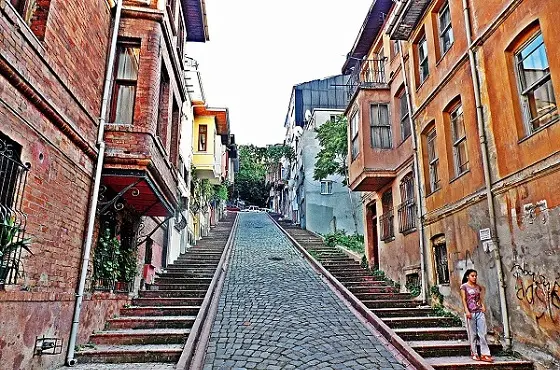
Three neighborhoods on the Golden Horn hold more layers of Istanbul than most guidebook districts: a pilgrimage town in Eyüp, then Balat and Fener, where Jewish, Greek, Armenian and Muslim Istanbul lived street by street. This walk runs from the hilltops of Eyüp down to the waterfront of Balat and Fener, then climbs again for one last view. Autumn, with its mild days and softer light, is a good time to do it.
1. Arrive by Ferry

The Golden Horn is the curved inlet that branches off the Bosphorus and splits European Istanbul in two. Ancient Greeks called it Chrysokeras, the “Golden Horn,” and the name stuck in almost every language.
The nicest way to reach Eyüp? By water. The Golden Horn ferry (vapur) run by Şehir Hatları, the city ferry company, sails from Üsküdar on the Asian side and Karaköy on the European side, calling at Fener, Balat and Ayvansaray before it ends at Eyüpsultan, and it takes the İstanbulkart, the city’s rechargeable transit card. Check the timetable before you go, since sailings are less frequent than on the Bosphorus lines.
2. Eyüp Sultan Mosque and Tomb

Eyüp is among the oldest and most sacred corners of the city. Its heart is the Eyüp Sultan Mosque and the tomb of Abu Ayyub al-Ansari, a companion of the Prophet Muhammad, which makes this one of the most visited pilgrimage sites in Türkiye. Don’t expect hushed silence. The square fills with vendors, families and pilgrims, and on weekends it is loud, busy and a little chaotic, while the pigeons strut around as if they own the place. Dress modestly to go inside: shoulders and knees covered, a headscarf for women, shoes off at the door, and avoid prayer times.
3. Climb Slowly to the Hilltop

“Slowly, slowly you will climb these stairs,” wrote the Turkish poet Ahmet Haşim, and the path up from Eyüp to the Pierre Loti hill is a good place to take his advice. A cable car runs to the top. Walk anyway. The half-stair, half-slope path climbs through the old Eyüp cemetery under tall cypresses, where poets, writers and statesmen are buried, Haşim among them. Cats and kittens line the way, and between stopping to greet them, you reach the summit before you notice the climb.
4. Pierre Loti Café and the View

At the top sits the café named after Pierre Loti, the French naval officer and novelist who fell for Istanbul in the 1870s. His diaries from that time became Aziyadé (1879), a novel named after the woman he loved here, and local tradition says he spent his free hours on this very hill. Photos from his life hang inside the small café, so you can look at them over a Turkish coffee. For the full bird’s-eye view of the Golden Horn and the historic peninsula, walk a little higher to the terraces above.
5. Balat’s Jewish Heritage

Leave Eyüp, pass Ayvansaray and you reach Balat, one of the oldest settlements on the Golden Horn. In the late 15th century, Sultan Bayezid II welcomed Jews expelled from Spain under the 1492 Alhambra Decree, and many of them settled here. Balat became the center of Jewish life in Istanbul for centuries.
Their houses still stand deeper in the neighborhood: usually three floors, narrow fronts and bay windows jutting out from the upper stories.
6. A Name From a Byzantine Palace

The name Balat most likely comes from the Greek palation, “palace,” after the nearby Byzantine Palace of Blachernae. It first named one of the city gates, then the whole district. Balat is part of the Historic Areas of Istanbul, inscribed on the UNESCO World Heritage List in 1985.
In the back streets, crumbling houses stand next to freshly restored ones painted in bright colors. A tiny old mosque on one corner and a large church a little further on seem to nod to each other. Women sit on their doorsteps and children play in the street.
7. Mosque, Synagogue and Church Side by Side

Jews, Greeks and Armenians all made Balat home. Each left buildings behind. Three synagogues are still in use, including Ahrida, founded in the 15th century, and the Armenian church of Surp Hreşdagabed stands nearby. Muslim Turks settled here too, and for centuries three faiths shared these few streets. Then, over the 20th century, most of the minority communities left. Today the neighborhood is overwhelmingly Muslim.
8. Agora Meyhanesi, a Tavern Since 1890
Agora Meyhanesi 1890 is a meyhane, the traditional Turkish tavern where rakı and small plates (meze) stretch dinner over hours. A Greek sea captain opened it in 1890 in Balat’s old market, and the original closed in the early 2000s before a new owner reopened it in the same building in 2014. Over the decades its tables drew poets and writers, including Özdemir Asaf and Necip Fazıl Kısakürek. Today it is known for a long meze list built on local Balat cooking. Book ahead for weekend evenings.
9. Çıfıt Çarşısı, the Old Market

When Jewish refugees from Spain settled in Balat, many opened shops in the market known as Çıfıt Çarşısı, from an old Turkish word for Jews that is now considered offensive. Most shopkeepers today are Turkish. Yet the street still feels like another decade. Tiny canteens (esnaf lokantası) serve home-style dishes under faded signs, next to a cobbler, a candy shop, a butcher, a pharmacy and a tailor, all with colorful windows and owners happy to chat.
10. The Red School of Fener

Walking from Balat toward Fener, you’ll see stepped lanes and very steep streets climbing uphill. On one of them, a red-brick building looms over the neighborhood like a castle: the Phanar Greek Orthodox College, which locals call the Red School or the Red Castle. The school traces its history to 1454, the year after the Ottoman conquest, and the current building went up between 1881 and 1883. It is one of the few Greek schools still running in Istanbul. Student numbers are small today.
11. Mesnevihane Mosque

In the streets above the Red School stands the Mesnevihane Mosque, built in the 19th century with rooms around its courtyard for reading and teaching the Masnavi, the great poem of the Sufi mystic Rumi (Mevlana). Purists may be disappointed, though: restoration work has changed much of its original character.
12. Dimitrie Cantemir’s House

Dimitrie Cantemir was twice prince of Moldavia, then a vassal state of the Ottoman Empire. Ruling was only half the story. He was also a historian, writer and composer. He spent most of the years between 1687 and 1710 in Istanbul, where he wrote Ottoman music in a notation of his own and preserved hundreds of instrumental pieces. The house he lived in, between the Red School and the Golden Horn, was restored and opened as a museum in 2007.
13. The Lived-In Streets of Balat and Fener

Turn into the narrow, sloping lanes of Balat and Fener and it feels like walking onto a film set. Old houses, some barely standing; laundry flapping on lines strung between windows; children racing up and down the hill. Many families here have little money, yet smiles come easily, and kids may well ask you to take their picture.
The neighborhood has changed fast since the 2010s. Many houses are now cafés, restaurants and guesthouses, painted in bright colors, and Balat has become one of the city’s busiest places for a stroll and a photo.
Ask before you photograph people, children above all.
14. The Ecumenical Patriarchate

After the conquest of 1453, Sultan Mehmed II made the Orthodox patriarch the spiritual and civil head of all Orthodox Christians in the empire, which secured the Patriarchate’s legal status. Since 1601 it has been based at the Church of St. George in Fener. Hence the shorthand: “Phanar” still means the Patriarchate itself. The Ecumenical Patriarch is regarded as “first among equals” among the heads of the Eastern Orthodox churches worldwide.
15. The Iron Bulgarian Church

Come back down to the shore and you’ll find Fener’s strangest building: the Bulgarian St. Stephen Church, a neo-Gothic church made almost entirely of cast iron. Its story begins in the age of nationalism. In 1870 Sultan Abdülaziz issued a decree creating the Bulgarian Exarchate, a church independent of the Greek Patriarchate up the hill. The current church replaced an earlier wooden one. Its prefabricated iron parts, about 500 tons in all, were cast in Vienna between 1893 and 1896, shipped down the Danube and across the Black Sea, and bolted together here by 1898.
Local lore adds that the sultan allowed only a few months to build it, which is why it had to be prefabricated; it makes a good story, but it isn’t documented.
What is certain: it is one of the world’s few surviving cast-iron churches, and after a long restoration it reopened in 2018.
16. Yavuz Selim Mosque and a Last Look

From the shore, climb the steep lanes once more toward Fatih and you reach the Yavuz Selim Mosque on Istanbul’s fifth hill. Suleiman the Magnificent built it in memory of his father, Selim I. It was finished in 1527/28. The view over the Golden Horn from its grounds is one of the best in the city.
It is the right spot for the lines of Yahya Kemal, a poet much loved across Turkey, in his poem “Aziz İstanbul” (Dear Istanbul), here in a loose translation:
Yesterday I looked at you from a hilltop, dear Istanbul. / There’s no place I saw that I didn’t love. / Sit on the throne of my heart as you please, for as long as I live. / Just to love one of your neighborhoods is worth a lifetime.
17. Bonus: Balat to Süleymaniye on Film
From Balat, the walk can carry on along the hills to the Süleymaniye Mosque. Serhat Aslan and Mesut Tuna made a short film of the route, set to a Turkish-language poem about friendship and Istanbul: watch it on YouTube. Most of the photos in this list are by Muzaffer Cemile Korkmaz.
Sources: Wikipedia, Balat, Wikipedia, Bulgarian St. Stephen Church, Wikipedia, Ecumenical Patriarchate of Constantinople, Time Out Istanbul, Agora Meyhanesi 1890





Bir yanıt yazın