
8 Abandoned Cities Reclaimed by Nature


Cities have been flooded, shaken apart by earthquakes, and flattened by wars, but some simply empty out when their people walk away. What happens next is the same almost everywhere: moss climbs the walls, sand drifts through the doorways, and animals take over the streets. These 8 abandoned cities reclaimed by nature show how quickly that handover can happen.
1. San Juan Parangaricutiro, Mexico

For weeks in early 1943, people in this town in the Mexican state of Michoacán heard thunder-like rumbles and felt the ground shake. Then, on February 20, a volcano opened up in a farmer’s cornfield nearby.
It was the birth of Parícutin.
The lava moved slowly, which turned out to be a lifesaver. The town was evacuated before the flows reached it, and no one was killed directly by the eruption. San Juan Parangaricutiro itself did not survive. Lava and ash eventually buried the town, leaving only the upper part of its main church standing above a black, frozen sea of rock. From a distance, the tower looks almost as if someone set it down on the lava on purpose. The residents rebuilt elsewhere, and the church ruins became a pilgrimage site and a tourist stop, with most visitors starting from the village of Angahuan, where local guides and horses are available.
2. Valle dei Mulini, Italy

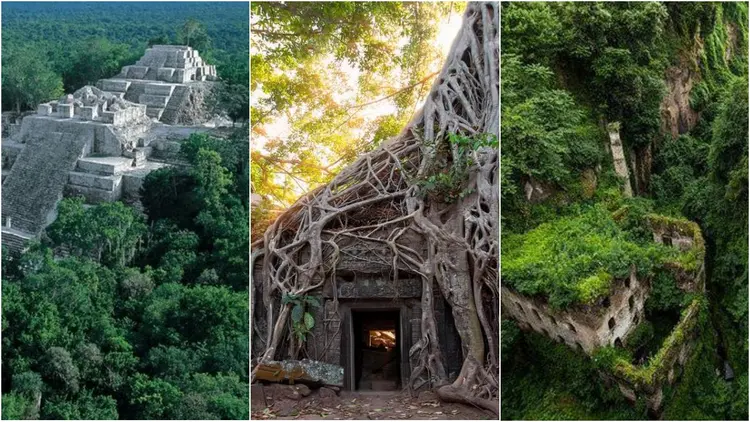
The name means “Valley of the Mills.” It fits exactly. In a deep gorge in the middle of Sorrento, on Italy’s Sorrento Coast, a flour mill used the stream at the bottom of the valley to grind wheat for the surrounding towns. Sources commonly trace the mills back to the 13th century, though the exact date is hard to pin down.
Over time a sawmill and a public wash house joined the mill. Then the 19th century cut the valley off. In 1866 part of the gorge was filled in to build what is now Piazza Tasso, the town’s main square, which blocked the sea breeze and left the valley floor humid and stale. Modern pasta mills elsewhere made the old flour mill obsolete, and by the first half of the 20th century the buildings had been abandoned.
Ferns and moss now cover the ruins.
Visitors don’t go down into the gorge; the classic view is from above, right next to Piazza Tasso.
3. Kolmanskop, Namibia

Kolmanskop began with a lucky find. In 1908 a railway worker named Zacharias Lewala picked up a shiny stone in the sand of the Namib Desert and showed it to his supervisor, August Stauch. It was a diamond. German miners rushed in, the colonial authorities fenced off a huge “forbidden zone,” and within a couple of years a small German town stood in the desert, complete with electricity from 1911.
The boom didn’t last. The diamond field started running dry during World War I, and in 1928 much richer deposits were found about 270 km (170 miles) to the south, near the Orange River. People followed the diamonds. The last residents left in 1956.
The desert came back for what it had lost.
Today dunes fill the living rooms and bathtubs of the old houses. Kolmanskop sits inside the restricted diamond area, so visitors need a permit, and tours are run by Namdeb, the diamond company jointly owned by the Namibian government and De Beers.
4. Houtouwan, China

Houtouwan is a fishing village on Shengshan Island, in the Shengsi Islands east of Shanghai. At its peak it was home to more than 2,000 fishermen and around 500 houses. So why would a village that size empty out? Put simply, its biggest problem was distance. Poor links to the mainland, limited schooling, and few jobs pushed families away from the 1990s onward, and by 2002 the village was essentially empty.
Nature moved in fast.
Vines have wrapped whole houses in green, so the hillside looks less like a ruin and more like a living sculpture. Houtouwan is no longer a place to live, but it is far from dead: it has become a popular tourist attraction, and some former residents now come back each day to work for the visitors.
Set it beside Kolmanskop and the pattern is familiar. Both places lost their people to something better elsewhere, richer diamonds in one case and the mainland in the other, yet one ended up buried in sand and the other in green.
5. Angkor Wat, Cambodia

Angkor Wat, in northern Cambodia, was commissioned by the Khmer king Suryavarman II in the first half of the 12th century as a Hindu temple dedicated to Vishnu. It is the best-known building of Angkor, the vast former capital of the Khmer Empire, and it is a UNESCO World Heritage Site.
After the empire’s capital moved on, much of Angkor was swallowed by forest. At some of its temples, giant tree roots still grip the stonework, which is exactly the “nature wins” scene many visitors come to photograph. Angkor Wat itself fared better. It was cleared and restored in the 20th century.
Despite its jungle-ruin reputation, Angkor isn’t really a ghost city. Unlike most places on this list, it never fully emptied, and Angkor Wat is still an active Buddhist place of worship.
6. Calakmul, Mexico

Calakmul lies deep in the rainforest of Campeche, on Mexico’s Yucatán Peninsula. Its oldest buildings go back to around 400-250 BC, and it reached its peak in the Late Classic period, when it was one of the most powerful Maya cities, with an estimated 50,000 people. It was abandoned in the 10th century. Then the forest took over.
Archaeologists have identified 6,750 ancient structures here. Some of its pyramids still rise above the treetops, and from the top you see little but jungle in every direction. The modern name, coined in the 1930s by botanist Cyrus Lundell, is usually rendered as “City of the Two Adjacent Pyramids.” In 2002 UNESCO added the ancient city and the surrounding tropical forest to the World Heritage List.
7. Okunoshima, Japan

Okunoshima, a small island in Japan’s Seto Inland Sea, is better known as “Rabbit Island.” Thousands of wild rabbits live here, they are used to people, and they will come running at the sound of a food bag. Nobody knows for sure how they arrived. The most common explanation is that rabbits were released after World War II, when the island was turned into a park, and that a local elementary school let more go in the early 1970s.
The island’s past is much darker. Between 1929 and the end of the war, a secret Japanese army plant here produced poison gas, and its existence was hidden for decades. A small Poison Gas Museum now tells that story, and the ruins of the factory still stand, though entry to them is prohibited.
The island belongs to the city of Takehara in Hiroshima Prefecture, and ferries run from Tadanoumi on the mainland. Friendly rabbits on a former poison gas island: few places pack a stranger contrast into so little space.
8. Ross Island, India

Ross Island, in India’s Andaman Islands in the Bay of Bengal, was where British colonial rule set up its penal settlement after the Indian Rebellion of 1857. In 1858 hundreds of convicts, many of them rebels, were shipped out and housed first in rough barracks on the island, where they were made to clear the forest. The island soon became the administrative headquarters of the penal settlement, and it stayed that way for decades. Japan occupied the islands during World War II, and the British never really moved back. Nobody cut the jungle back. It returned, and tree roots now hold the old buildings together and pull them apart at the same time.
In 2018 the island was officially renamed Netaji Subhas Chandra Bose Island. No civilian settlement is allowed there today, but the ruins draw a steady stream of visitors.
Sources: History Hit, Wikipedia: Kolmanskop, Wikipedia: Calakmul





Bir yanıt yazın