
Hanging Temple: China’s Monastery Built Into a Cliff


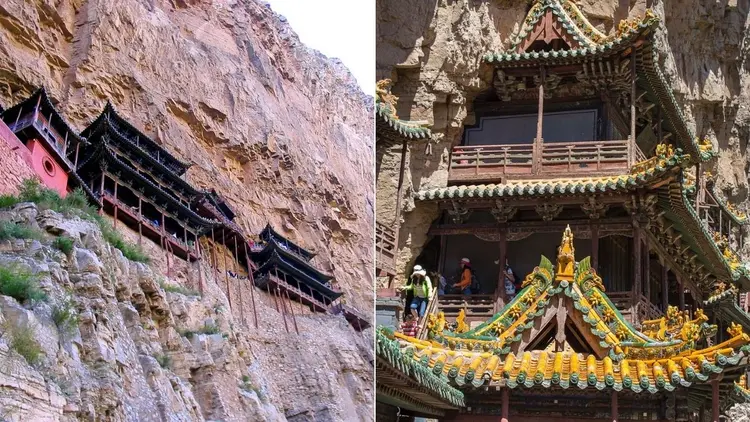
Picture a temple pinned to a sheer rock face, its wooden halls hanging high above a gorge as if gravity had been politely asked to look away. That is the Hanging Temple, also known as the Hanging Monastery or Xuankong Temple, in Shanxi Province, China, about 64 km (40 miles) from the city of Datong.
1. A temple that seems to float on a cliff

The temple sits on the west side of Jinxia Gorge, near Mount Heng in Hunyuan County. From below, the effect is odd. The red-and-wood pavilions look less like a building and more like something the cliff decided to grow.
It’s also unusual on the inside. Officially a Buddhist site, the Hanging Temple makes room for Taoism and Confucianism, China’s three traditional schools of thought, and few places put all three in one building, let alone one stuck to a mountain.
2. Why build a temple halfway up a cliff?

According to legend, a monk named Liaoran founded the temple in 491 AD. Choosing a cliff face for a place of worship was hardly the easy option, and that seems to have been part of the point: devotion shown through sheer effort.
There were practical reasons too. A common explanation holds that temples built near rivers in the area were often damaged by floods, so this one was placed out of the water’s reach; its position under the overhanging summit shields it from rain and direct sunlight. Whether the builders planned all of this or simply got lucky is hard to say. Either way, it helps explain how so much timber has lasted so long.
Then there is the symbolism. With Buddhist, Taoist, and Confucian figures sharing the same halls, the temple is often read as a statement of harmony between the three traditions.
3. Natural hollows and ledges became the floor plan

The builders didn’t fight the cliff. They used it. Natural hollows and rocky outcrops were worked into the design, and the complex sits in a recess in the rock about 10 m (33 ft) deep.
Inside that compact footprint there are 40 halls and pavilions, all more than 30 m (98 ft) above the ground, arranged in a northern and a southern section and linked by narrow bridges, wooden walkways, and passages. Walking through it feels a bit like moving between treehouses, if the tree were made of granite.
4. How does the Hanging Temple stay up?
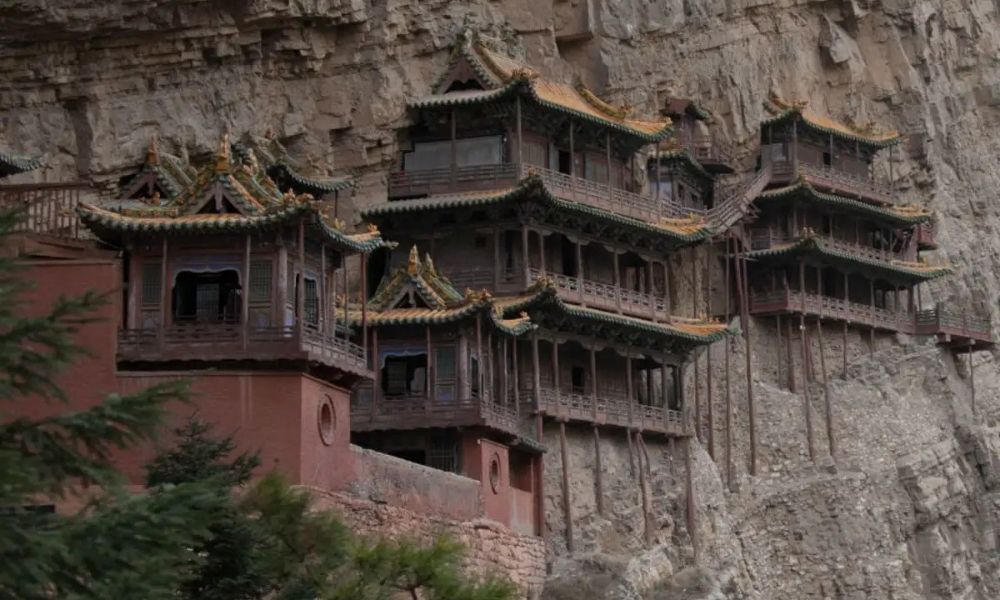
Every visitor asks this.
Most traditional Chinese temples stand on flat ground. Not this one. The Hanging Temple relies on oak crossbeams fitted into holes chiseled into the cliff, and its main supporting structure is hidden inside the bedrock. A set of 27 wooden beams supports the main buildings. It’s tempting to assume the slender posts underneath hold the whole thing up. They don’t, at least not on their own: the rock does the heavy lifting. Iron chains and beams were added as reinforcement over the centuries. The result combines engineering, aesthetics, and religious purpose in a way few buildings anywhere manage, which is why it has become one of the best-known showcases of traditional Chinese architecture.
5. Buddha, Confucius, and Laozi under one roof

Step inside the Hall of Three Religions and you’ll find Śakyamuni (the historical Buddha) in the middle, Laozi, the founding figure of Taoism, on the left, and Confucius on the right.
Three traditions, three founders, one small room.
Across the complex there are more than 80 statues in bronze, iron, clay, and stone. Some are Tang dynasty work. Other halls honor the bodhisattva Guanyin and Lü Dongbin, one of Taoism’s Eight Immortals. The Sanguan Hall, the largest in the temple, holds Ming-era clay figures of the Three Officials.
6. Getting there, and the Northern Wei story behind it

Reaching the temple is fairly simple. Travelers usually head to the Hengshan Visitor Center, take a shuttle for the last stretch, and then climb the stairways and walkways on foot. The passages are narrow and high. Anyone uneasy with heights should take it slowly; this is not a place to rush. The wider Datong area is known for its coal-mining heritage, which some visitors explore as a side trip.
In 386 AD the Tuoba clan of the Xianbei people founded the Northern Wei dynasty, and in 398 they made Pingcheng, today’s Datong, their capital. The dynasty became a major patron of Buddhism (the nearby Yungang Grottoes date from the same era), and the Hanging Temple itself was founded in 491, late in the Northern Wei period. It has now stood for more than 1,500 years.
7. Datong drew dynasties long after the Northern Wei

Centuries later, the Khitan-led Liao dynasty turned the region into an important Buddhist center. The Jin dynasty took over in the 1120s and left its own mark on the temples it inherited. Two highlights from this period survive. Huayan Temple in Datong was founded under the Liao in 1038 and rebuilt by the Jin, while in nearby Ying County the Pagoda of Fogong Temple, built in 1056, is the oldest fully wooden pagoda still standing in China.
Into history or architecture? Then the region is a rich stop.
8. Rebuilt under the Ming and Qing, still on the cliff

Much of what stands today was rebuilt during the Ming (1368-1644) and Qing (1644-1912) dynasties; a stone tablet dated 1864 records a later reconstruction, and a restoration of its paintings and decoration was approved more recently, in 2015. The public returned in May 2016.
Today it draws large numbers of visitors every year. Honestly, it’s easy to see why. If a trip to northern China is on the cards, the Hanging Temple is well worth adding to the list.
Sources: Wikipedia, 7wonders.org















Bir yanıt yazın