
Maiden’s Tower History in 11 Legends and Poems


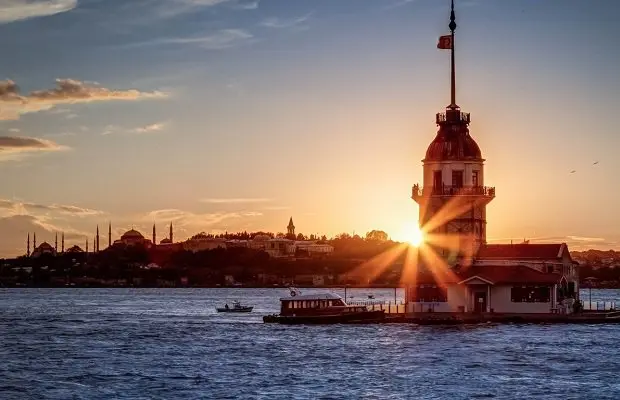
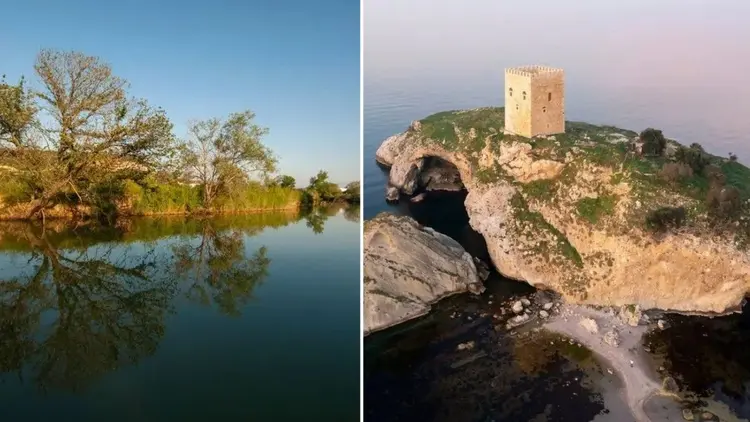
Small enough to walk around in minutes, the Maiden’s Tower (Kız Kulesi in Turkish) sits on a rock in the Bosphorus off Üsküdar, on the Asian side of Istanbul, and has collected more stories than buildings ten times its size. The Maiden’s Tower history runs from an Athenian toll post to a lighthouse, and the legends layered on top are just as busy: lovers, a doomed princess, a folk hero on horseback. Each stop below is paired with lines by a Turkish poet, translated here, because few landmarks in Türkiye have been written about as often.
1. From Ancient Greece to Today

…ripples silvering from Kuzguncuk to Salacak
like a mysterious woman
dress up for the night
the Maiden’s Tower
with the glint of a tarnished diamond ring
sets its sorrow afloat on the water…
Ceyda Görk
A symbol of both Istanbul and the Üsküdar district, the tower stands on a tiny islet where the Bosphorus, the strait joining the Black Sea and the Sea of Marmara, is at its most photogenic. Its story starts around 408 BC, when the Athenian general Alcibiades is believed to have set up a customs post on the rock to tax ships coming down from the Black Sea. The building you see today is far younger. It is mostly Ottoman, rebuilt in stone in 1763 and restored again by Sultan Mahmud II in 1832.
European travelers have long called it Leander’s Tower, a name with a story of its own (see stop 7).
2. Evliya Çelebi Described It Too

…The Maiden’s Tower trades glances with Üsküdar
day breaks dome by dome in its crescent
friend and foe all make peace here
age by age I wander Istanbul…
Yakup Kavas
Evliya Çelebi, the 17th-century Ottoman traveler whose ten-volume Seyahatname (Book of Travels) is one of the great travel books of any era, stopped to describe it. He placed it in the sea, “an arrow’s flight from the shore.” Square, high, skillfully made. Its height, he wrote, was 80 arşın, an old Ottoman unit roughly the length of an arm. Two doors, one on each side, opened at ground level.
3. A Tomb, a Toll Post, a Quarantine Station

…pull yourself together, pull yourself together
I’ll shoot you, Istanbul
I’ll shoot you from your greenest spring
from your Maiden’s Tower, from Aşiyan, from Bebek
I’ll shoot you from your sea and you’ll bleed deep blue…
Ceyda Görk
Few buildings have changed jobs this often. Greek tradition puts a tomb on the islet, and the ancient toll post came next. In 1110 the Byzantine emperor Alexios I Komnenos fortified the rock with a tower and a wall, and in 1453 a small Byzantine garrison held it during the Ottoman conquest of the city. The Ottomans used it as a watchtower, later as a lighthouse, and from 1829 as a quarantine station during epidemics; local accounts add a stint as a place of exile. The latest chapter is a museum: after a 2021-2023 restoration, it reopened to the public in May 2023.
4. A Lighthouse That Still Guides

…From the Bosphorus comes
the sound of a ferry leaving a pier,
and once again above the blue water
the snow-white Maiden’s Tower…
Ziya Osman Saba
After a fire in 1721, the grand vizier Damad İbrahim Pasha ordered a new building, and it was put to work as a lighthouse. A light winking at passing ships became its signature. Ask anyone in Istanbul and the light is what they picture at night. Somewhere along the way it also started guiding something less practical: daydreams, love letters, and a steady supply of poems.
5. A Tower in Chains

Don’t be fooled by the Maiden’s Tower’s careless air.
However uninterested it may seem,
truth is, its heart is set on Galata too.
İbrahim Uğur Toprak
Under Alexios I, an iron chain ran from the tower across the water to another tower in the Mangana quarter on the European side, a way to control traffic through the strait. Ships of the day were small enough to slip through the gap between the tower and the Asian shore. A local story goes further: the tower could not bear the weight of the chain and toppled toward the European side, and its remains can still be seen in the water when you look down from the islet. Pleasant to imagine. Hard to prove.
6. A Temple to Aphrodite

…an Eskimo poet touches my shoulder
and, pointing at the Maiden’s Tower,
says stop grieving now
in this city of seven hills
the only place to read poetry
is of course that little iceberg
in the middle of the sea…
Sunay Akın
The local version of the Hero and Leander tale begins with a temple to Aphrodite on the slopes of Üsküdar. Hero was one of its young priestesses. Love was forbidden to her. Her task at the tower was to look after the turtledoves. Every spring, festivals celebrated nature’s reawakening around the temple, with food and drink, and anyone still alone prayed to Aphrodite to find love. Anyone, that is, except Hero.
7. A Love Story the Bosphorus Pulled Apart

…The Maiden’s Tower is the music box
of children afraid of the dark
the ballerina who starts to dance
when the lid opens
gets her dress wet
from the pranks of mischievous gulls
Sunay Akın
Leander, who lived on the opposite shore, came over for the festival, met Hero, and the two fell in love. From then on he crossed every night, and the tower kept their secret. One stormy night a jealous priest put out the tower’s light; Leander lost his way in the dark and drowned, and Hero, heartbroken, threw herself into the sea after him.
It is a lovely story, just not originally Istanbul’s.
In the Greek myth, Hero lived at Sestos on the Hellespont (today’s Dardanelles), Leander swam over from Abydos, and it was a winter wind, not a priest, that blew out her lamp. The two straits look alike, and the legend simply moved north.
8. The Princess Hidden From a Snake

…Istanbul is a mother
rocking her child on a suspension bridge
and the Maiden’s Tower
is her baby bottle full of milk
held in the water to cool
Sunay Akın
Another legend, and the one behind the Turkish name, stars a Byzantine emperor overjoyed at the birth of a daughter. He summoned the empire’s wisest scholars to raise her. One brought a grim prophecy: on her 18th birthday, a snakebite would kill her. Shaken, the emperor had the tower on the little islet fitted out and moved her there, safe, he believed, from every snake on land.
9. …And the Snake Got In Anyway

1- in the mornings I dust her photographs, I kiss them
our affection won’t fit inside frames
Maiden’s Towers on all four sides of us
the women of Isfahan carry eyes in their faces
the turtledoves of Shiraz, a warm nest
the Maiden’s Tower, a diamond
The years passed and the princess turned 18. Despite every precaution, a snake reached the tower hidden in a basket of grapes sent to her as a gift, bit her before anyone noticed, and she died. The grieving emperor understood that fate cannot be dodged. Fearing snakes would reach her in the ground too, he had her body embalmed, laid in a brass coffin, and placed high on one of the walls of Hagia Sophia, so that at least in death she would be out of their reach. Set it next to the Hero and Leander story and the pattern is plain: both times the tower was meant to protect someone, and both times it failed.
10. Battal Gazi at the Maiden’s Tower

2- whoever’s role I take on, I’m a stranger to myself
a hand smelling of basil reaches out
the Maiden’s Tower in my embrace
no, I said, those aren’t black olives
they are her kohl-lined eyes, my captivity on Mount Ida
let the Maiden’s Tower wait
A third tale belongs to Turkish folklore. Battal Gazi is a hero of Turkish epics, built on the legend of al-Battal, an 8th-century Arab commander who fought the Byzantines. Where the real commander ends and the epic hero begins is hard to pin down. In the story, he raided the tower with his men, carried off its treasure, and took the daughter of the Byzantine lord of Üsküdar (the tekfur, as Turkish tales call such rulers). Behind the raid lies a failed siege: unable to take the city, Battal Gazi set up camp on the shore facing the tower and stayed for seven years.
11. Whoever Gets the Horse Has Already Crossed Üsküdar

3- I was wrong, her eyes were blue, and her voice too
her words, fish risen from the seas
let the Maiden’s Tower burst with envy
migrate to other thoughts and you’re another photograph
painting you would take me a lifetime
am I wrong, Maiden’s Tower
Barış Erdoğan
Why seven years? The tale’s answer is love: Battal Gazi had fallen for the lord’s daughter. Frightened of him, the lord locked her in the tower with his treasure. Back from a campaign in Damascus, Battal Gazi rowed out, took both the girl and the gold, jumped on his horse at Üsküdar and was gone before anyone could stop him. Folk tradition traces a Turkish saying to this moment, “Atı alan Üsküdar’ı geçti,” roughly “whoever gets the horse has already crossed Üsküdar,” which means it is too late.
The princesses of these stories also gave the tower its Turkish name: Kız Kulesi, the Maiden’s Tower.
Sources: Wikipedia, Maiden’s Tower, Wikipedia, Hero and Leander, Wikipedia, Abdallah al-Battal, Maiden’s Tower official site







Bir yanıt yazın